
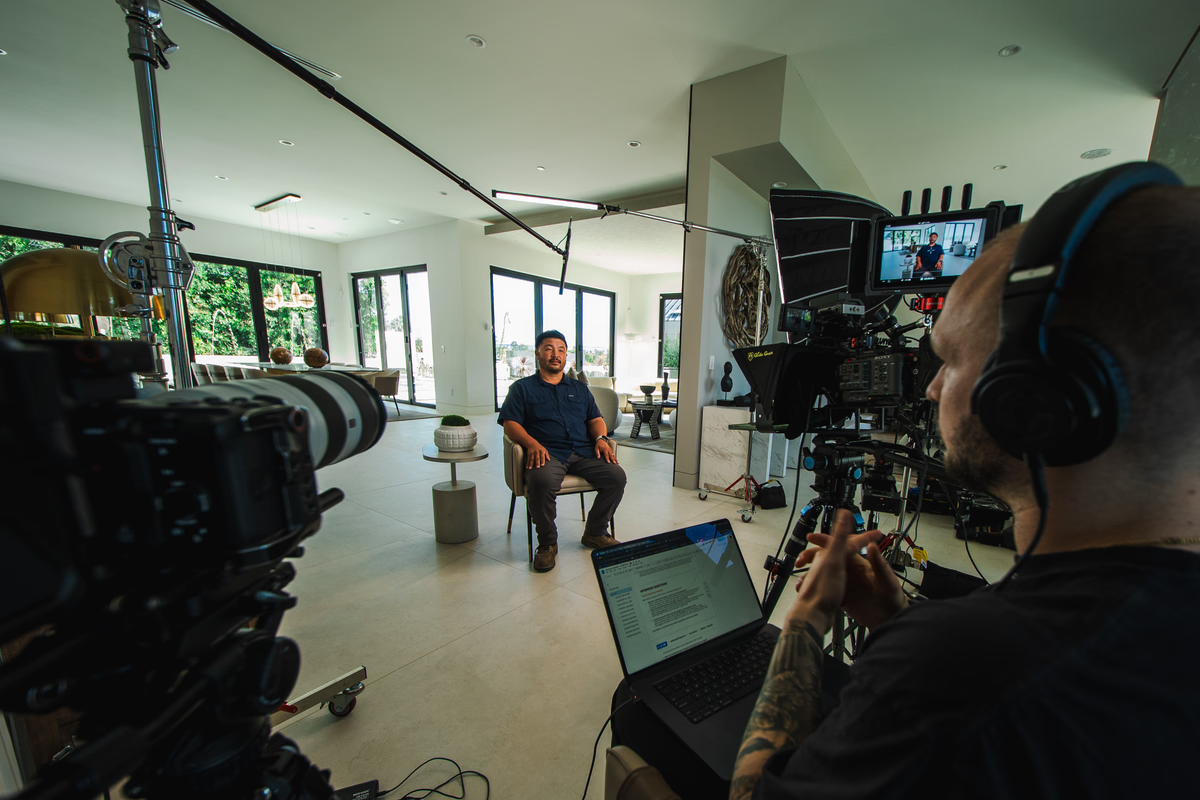
Paid video gets you in front of people who weren't looking for you. Video SEO gets you in front of people who are. The math on CAC over 24 months makes the case for organic — decisively.
What You'll Learn
- Why distribution planning comes before production planning
- The three SEO signals that video content controls
- How to structure a video for both viewers and algorithms
- The metadata stack that gets your video ranked
Every year we run the same numbers for new clients. Paid video: high CAC, zero residual value, stops the moment the budget does. Video SEO: higher upfront investment in quality, but a cost-per-lead that compounds downward for 24–36 months after publish.
The catch is that video SEO requires a strategy built before the camera rolls — not after delivery.
The Distribution Trap Most Brands Fall Into
Most brands treat distribution as a post-production problem. They finish the video, then ask: where should we post this? That question, asked at that moment, is already too late. The decisions that determine whether a video ranks — title structure, chapter markers, thumbnail strategy, keyword density in spoken dialogue — are made during production, not after.
We've worked with clients who produced exceptional videos that performed poorly because there was no distribution brief. And we've seen modest productions — well-structured, keyword-optimized, properly chaptered — that outperform their budget by a factor of 10 over an 18-month window.
Forrester Research, 2025 — pages with relevant video embedded rank significantly higher for target keywords.
How Video SEO Actually Works in 2026
YouTube and Google process video differently to text, but the core logic is similar: they're trying to determine relevance and authority for a given search query. For video, there are three primary signals they use.
First, metadata: title, description, tags, and closed captions. The algorithm can't watch your video — it reads about it. Every word in your title is a keyword decision. Every paragraph of your description is a content brief the algorithm parses for relevance.
Second, engagement signals: watch time, click-through rate, comments, and shares. These tell the algorithm whether the content is delivering on the promise the title makes. A high-CTR, low-watch-time video gets penalized. A modest-CTR, high-watch-time video gets promoted.
Third, authority: channel history, domain embedding, and backlinks. This is the long-game advantage — a well-established YouTube channel or a high-DA website with embedded video will rank a new video faster than a fresh channel will.
Key Takeaways
- Video SEO strategy must be defined before the production brief is written
- Keyword research for video is different from text SEO — search intent skews toward 'how-to' and 'what is'
- Chapter markers (timestamps) directly improve watch time by letting viewers navigate to relevant sections
- Closed captions, when accurate, meaningfully improve keyword indexing
The Pre-Production SEO Checklist
Before we enter pre-production on any SEO-oriented video, we run through a checklist that ensures the production decisions support the distribution goals. It starts with keyword research.
Target one primary keyword per video. Build your title around it. Use the first 125 characters of your description to restate the keyword in a natural sentence. Then use the spoken intro — the first 30 seconds of the video — to say the keyword phrase out loud. Captions are indexed, and the algorithm weighs early content more heavily.
Want a production built for search?
Our 30-Day Brand & Video Sprint builds your distribution strategy before the camera rolls — so every asset is optimized before it is shot.
See the SprintBuilding a Video Content Calendar That Compounds
Single-video SEO is a tactic. A content calendar built around a keyword cluster is a strategy. The brands that win on YouTube over a 24-month period are the ones that treat video like a publishing operation, not a campaign.
Start with a pillar topic — the broad keyword that represents your category. Then build spoke videos around long-tail variations of that keyword. Each video links to the others in descriptions and pinned comments. The channel builds topical authority over time, and each new video benefits from the authority established by the previous ones.
Frequently Asked Questions
About the Author

Lear
Distribution Strategist
Lear builds the distribution layer that turns a production into a marketing asset. He maps platform sequencing, SEO structure, and content deployment — making sure what LOOK delivers actually reaches the right audience. Brought in on strategic sprints where distribution is planned before the camera rolls.